 Skip to content
 Deck Builders Greenwich : Harbour Peninsula Specialists
Sloping Blocks | Harbour Views | Salt Air Engineering | Lane Cove Council | Licensed 214155C
Stand at Greenwich Point Reserve on a clear afternoon and the view stretches across Sydney Harbour in three directions. For deck builders Greenwich homeowners trust, that view potential is both the opportunity and the engineering challenge – almost every property on this harbour peninsula has some aspect of slope, salt air exposure, and view orientation that shapes how a deck must be built. Seven kilometres from the CBD, the suburb sits quietly between the Lane Cove River and the harbour, with a property market at $3.95M median that reflects exactly what that position is worth. NSW Licence 214155C. Call 0411 763 469.
A Peninsula Where Almost Every Property Has View Potential
Greenwich occupies a narrow peninsula at the opening of the Lane Cove River into Sydney Harbour – water on the east (harbour), water on the south (Gore Cove), water on the west (Gore Bay and Lane Cove River). That geography has two direct consequences for deck construction. First, almost no property in Greenwich sits far from tidal water, which means salt air exposure affects every deck in the suburb, from foreshore mansions down to mid-street homes a few hundred metres from the water’s edge. Second, the peninsula topography drops from the central ridge down to the waterfront in all directions, creating the sloping blocks that define most Greenwich rear yards.
Salt air is not a problem that happens only to a few Greenwich properties. It is a condition that affects most sites to some degree.
Within 300 metres of tidal water – which covers much of the suburb – standard galvanised fixings can show surface corrosion within a few years. The safer specification for many Greenwich positions is Grade 316 stainless throughout the deck’s fixing system, H4 or H5 treated subframe timber where appropriate, and decking species selected for their performance in sustained coastal exposure. Ironbark and Spotted Gum generally outperform Merbau in exposed conditions because their tighter grain structure better resists the moisture cycling that salt air accelerates.
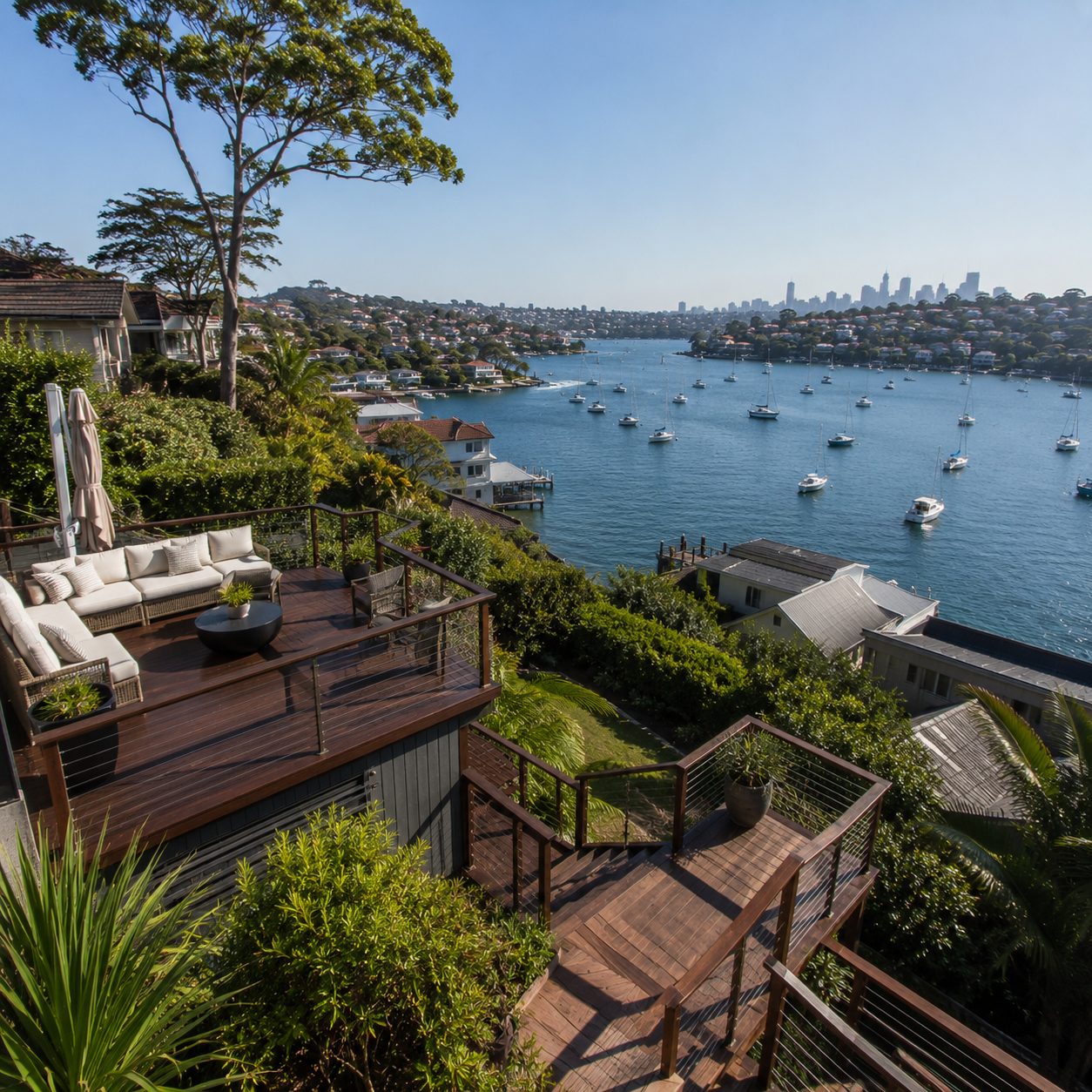
The sloping terrain creates multi-level deck briefs as the suburb’s most common project type. A home on Elamang Avenue or Mitchell Street typically sits 3-5 metres above the back fence line, with a harbour or river view opening up from the upper position. Capturing that view while safely managing the elevation change – and getting it through Lane Cove Council or certifier review where required – is the core engineering and planning challenge of deck construction in Greenwich.
Greenwich Property Types and What They Need From Decks
GREENWICH IN NUMBERS: Population 5,469 – one of Sydney’s smallest suburbs by headcount. Median house price $3.95M. 65% owner-occupied. 64.9% couples have children. Predominant age 40-49. Professional occupations are dominant. Only 47 house sales in the past 12 months – very tightly held. These figures describe a suburb of established, high-income families who bought carefully, invested substantially in their properties, and do not plan to move. Their renovation decisions, including decks, reflect long-term ownership intent rather than pre-sale preparation.
The housing stock divides broadly into three categories. Waterfront and near-waterfront homes on the foreshore streets – Gore Street, Elamang Avenue, the streets running toward Greenwich Point Reserve – command premium prices for direct harbour access and are the suburb’s most architecturally diverse properties. Heritage-listed and significant period homes occupy many of Greenwich’s established streets – including Greenwich House, a Georgian sandstone home dating from 1836 that remains standing. Modern renovated homes and contemporary builds sit through the suburb’s mid-streets, often on the 600-800m² blocks that the subdivision created through the post-war decades.
Deck briefs across these property types share one consistent feature: the view. Whether the property has direct harbour frontage or just a glimpse of the Lane Cove River through the trees, Greenwich homeowners consistently design decks to orient toward water. Positioning matters as much as materials – the deck that captures the view from the kitchen outlook is the deck that actually gets used every day.
Outdoor Living in a Harbour Peninsula Suburb
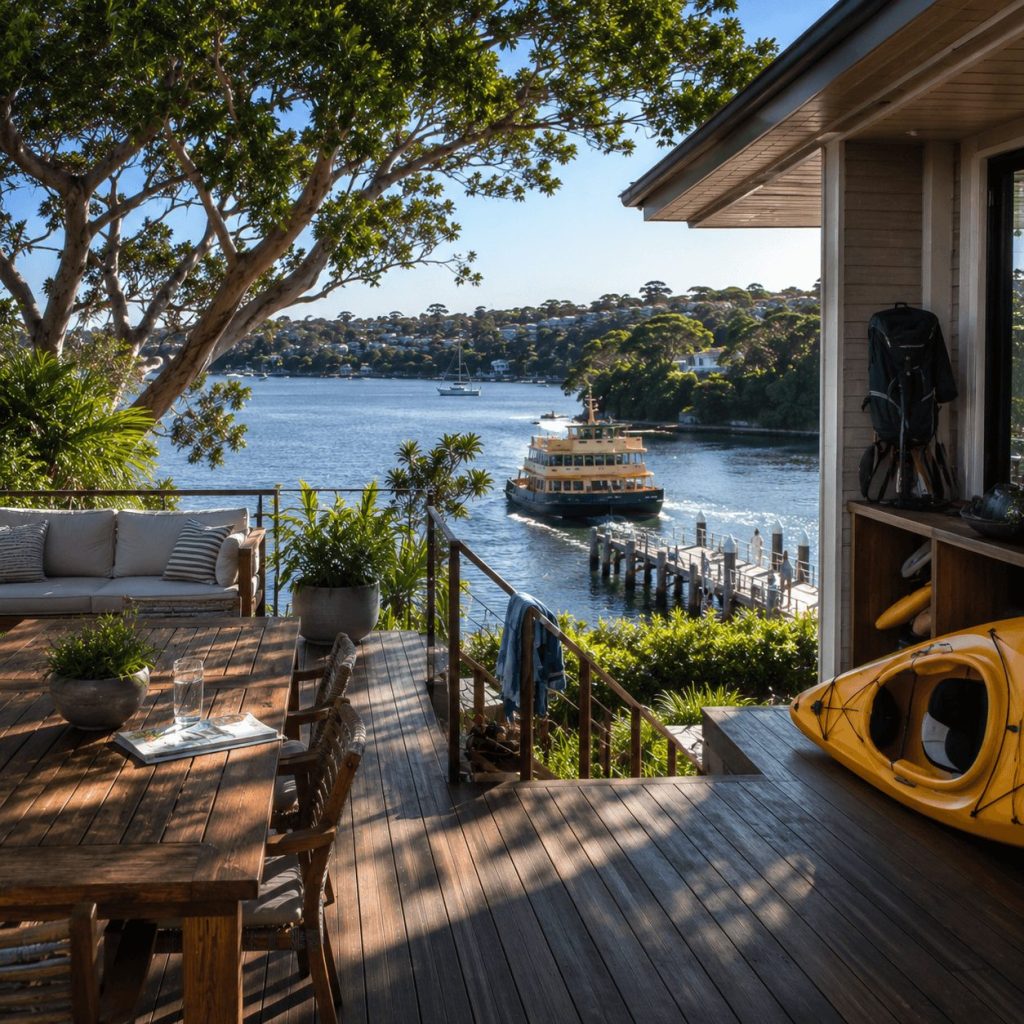
Greenwich has two sailing clubs – one at the mouth of the Lane Cove River, one off Greenwich Point – and a harbour swimming pool at Greenwich Baths with a shark net. Two ferry wharves connect the suburb to Circular Quay and Cockatoo Island. The suburb’s relationship with water is active rather than merely visual. Residents sail, swim, kayak, and use the harbour as a genuine recreational environment rather than just a backdrop.
That active relationship with water shapes how decks are used. Greenwich decks are regularly planned around arrival and departure routines – the place where you drop sailing gear before going inside, where you have a drink after coming off the water, and where guests gather before walking down to the ferry. The deck is not just a destination; it is the transition space between the house and the water environment that the suburb wraps around. Design responds to this: good access from the house, easy flow toward the garden stairs, and weatherproof storage consideration where site conditions allow.
The suburb’s small population – just 5,469 in 1.6 square kilometres – creates genuine community density. When a deck project is done well in Greenwich, it is noticed. When it is done poorly, that is noticed too. Experienced deck builders in Greenwich need to account for that level of visibility by prioritising clean detailing, durable materials, and site-sensitive design from the start.
Lane Cove Council - Approval Guidance for Greenwich Decks
Greenwich falls within the Lane Cove Council LGA. Deck approval requirements depend on a range of site-specific factors. The following is general guidance – requirements should be confirmed with Lane Cove Council or a registered certifier before construction begins.
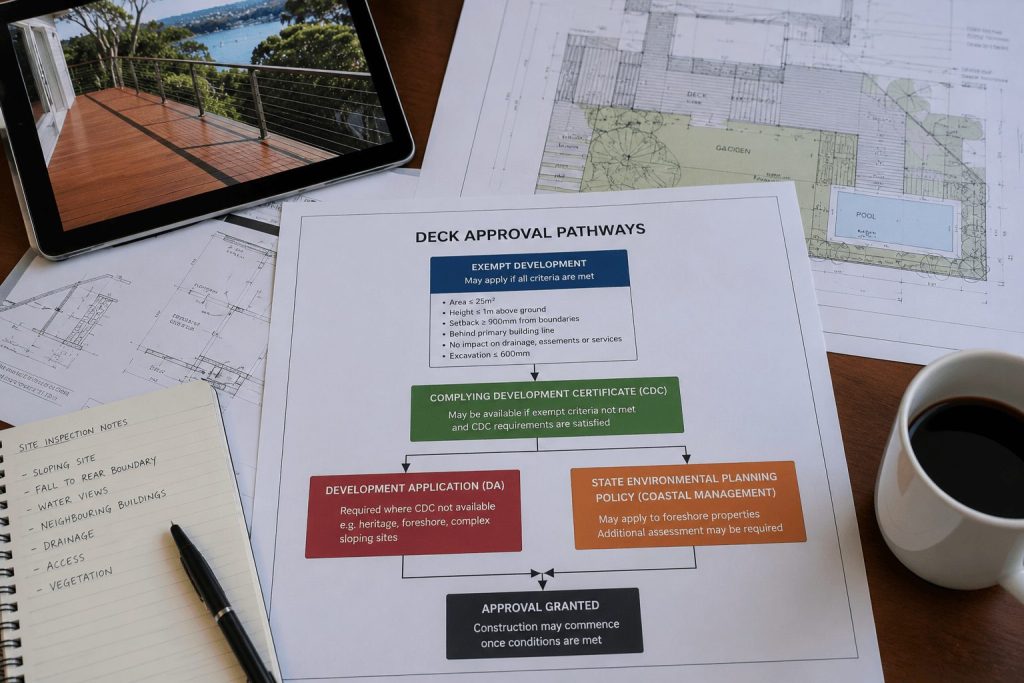
Exempt Development – May Apply
Some decks may qualify as exempt development under NSW SEPP (Exempt and Complying Development Codes) 2008, where all relevant criteria are met. Conditions that would generally need to be satisfied include:
- Total area does not exceed 25 square metres
- Floor height does not exceed 1 metre above the existing ground at any point
- Setback of at least 900mm from all property boundaries
- Located entirely behind the primary street-facing building line
- No impact on drainage, easements, or utility services
- Excavation does not exceed 600mm
Important note: Exempt development may not apply on sloping sites where deck height exceeds 1m at the low end, on heritage-listed properties, in areas with foreshore or flood constraints, or where drainage or easement issues exist. Greenwich’s sloping Peninsula terrain means many properties do not meet the 1m height criterion at all points – making council or certifier review likely for many projects.
CDC and DA Pathways
Decks that exceed exempt criteria may be eligible for a Complying Development Certificate. Where CDC is not available – including foreshore-adjacent properties, heritage sites, or complex sloping sites – a Development Application may be required. Foreshore properties in Greenwich may also be subject to State Environmental Planning Policy coastal management provisions. We identify the applicable pathway during initial site inspection.
Popular Deck Styles for Greenwich Properties
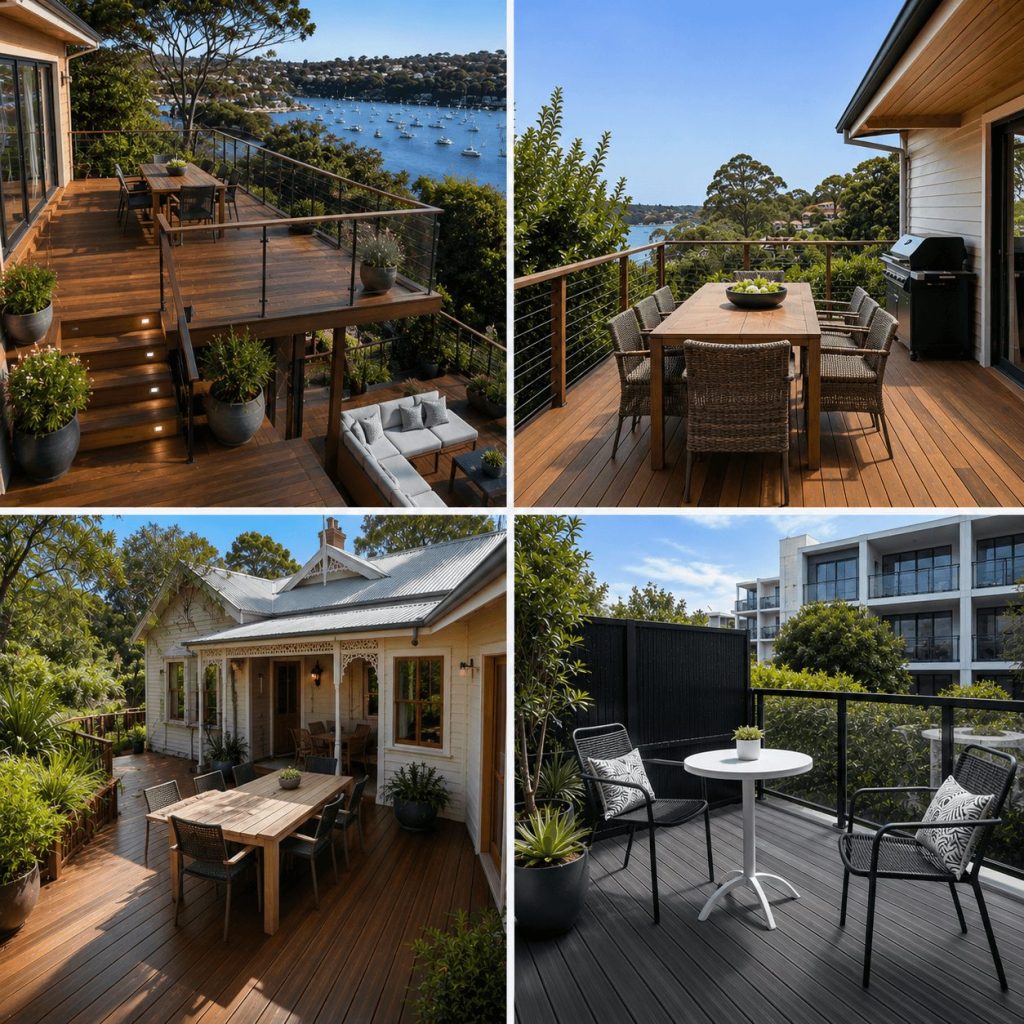
Harbour View Multi-Level Decks
Greenwich’s most common and most dramatic deck project type. Sloping sites with 3-6 metre falls between the house and the waterfront boundary. Upper entertaining level off the kitchen or living area. Lower terrace stepping toward the view. Glass or stainless cable balustrades on harbour-facing edges – the view is the point, and solid balustrades defeat it. Engineering certification is generally required for elevated post positions. Grade 316 stainless fixings are recommended as standard for foreshore-proximate positions. Budget $30,000-$65,000 depending on size and complexity
Mid-Street Single-Level Entertaining Decks
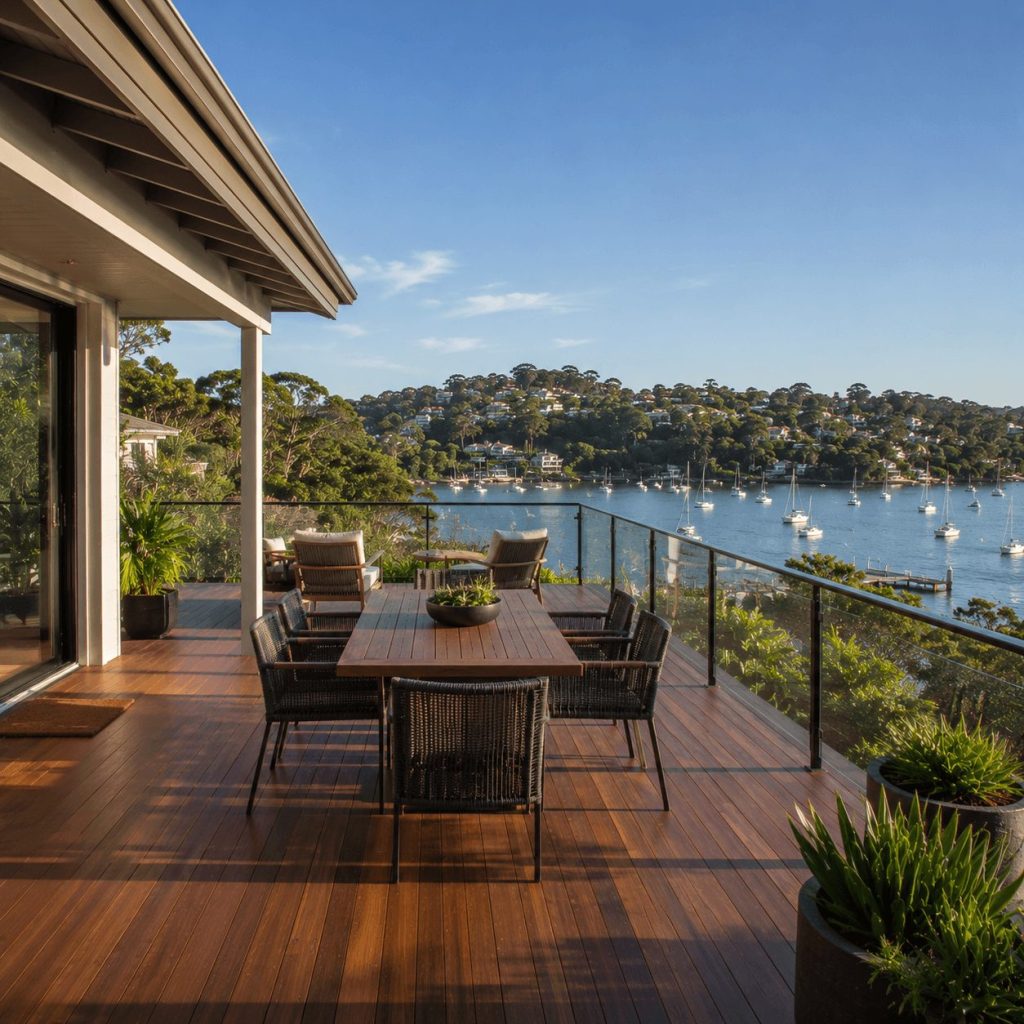
Properties on Greenwich’s mid-elevation streets – where the slope is moderate, and the view is more glimpse than panorama – suit single-level hardwood decks of 30-40m². Spotted Gum or Ironbark for the salt air environment. Natural oil finish. Cable or glass infill on harbour-facing edges to preserve the water view. More manageable engineering than foreshore sites. The CDC pathway may be available depending on height, setbacks, drainage and site conditions.
Heritage Home Sympathetic Timber Decks
Greenwich’s period homes – Federation bungalows, inter-war properties, and some significant Georgian and Victorian heritage – call for decks that respect the host building’s architectural period. Spotted Gum or Merbau in period-appropriate board widths. Natural oil finish. Traditional post profiles. Deck design assessed against Lane Cove Council heritage controls where applicable. These projects can involve heritage impact assessment as part of the approval process
Compact Courtyard and Apartment Balcony Upgrades
Greenwich’s smaller unit stock – median unit price $914,000, strong 17.75% annual growth – generates demand for balcony composite upgrades. Ekodeck or TREX in grey tones. Strata coordination managed. Quick installation. Low maintenance is particularly relevant given the salt air environment, which makes hardwood balconies more maintenance-demanding than in sheltered inland locations.
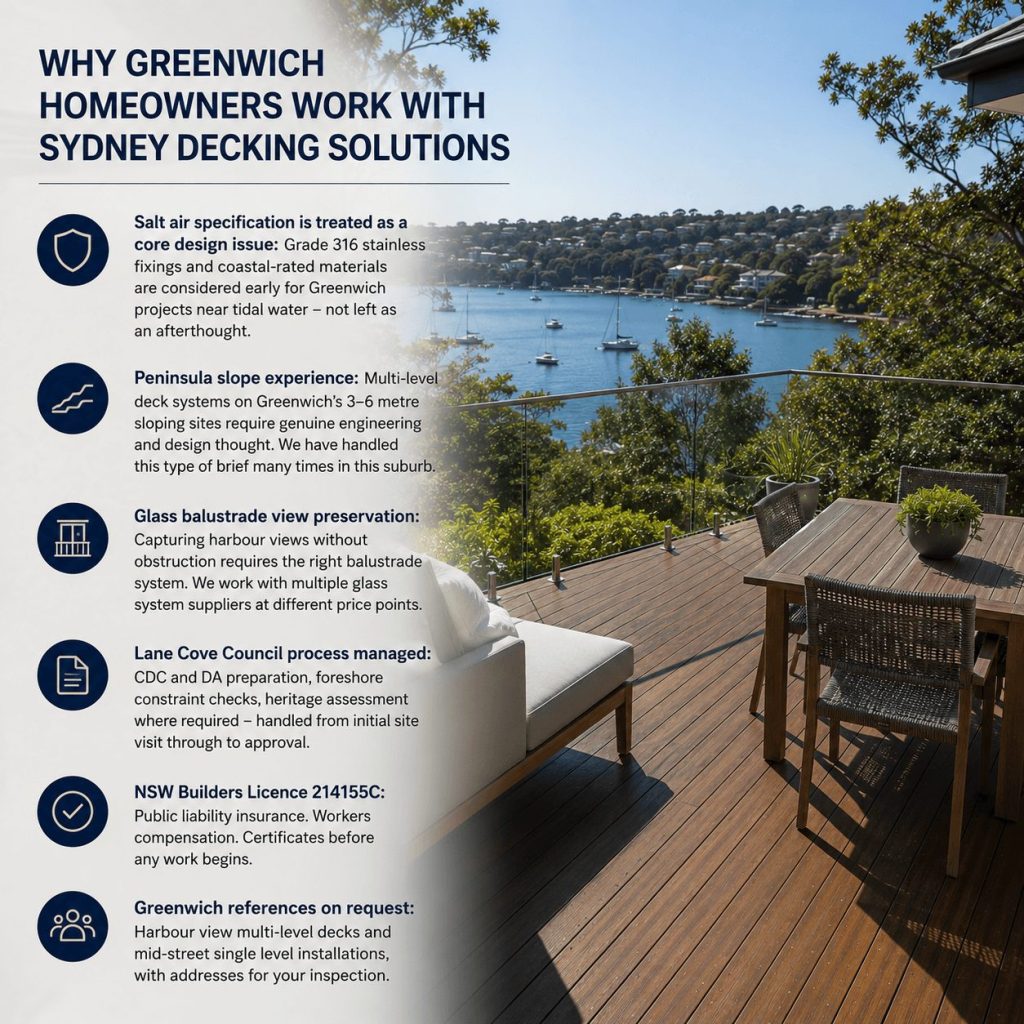
Why Greenwich Homeowners Work With Sydney Decking Solutions
- Salt air specification is treated as a core design issue: Grade 316 stainless fixings and coastal-rated materials are considered early for Greenwich projects near tidal water – not left as an afterthought.
- Peninsula slope experience: Multi-level deck systems on Greenwich’s 3-6 metre sloping sites require genuine engineering
and design thought. We have handled this type of brief many times in this suburb. - Glass balustrade view preservation: Capturing harbour views without obstruction requires the right balustrade system. We work with multiple glass system suppliers at different price points.
- Lane Cove Council process managed: CDC and DA preparation, foreshore constraint checks, heritage assessment where required – handled from initial site visit through to approval.
- NSW Builders Licence 214155C: Public liability insurance. Workers compensation. Certificates before any work begins.
- Greenwich references on request: Harbour view multi-level decks and mid-street single-level installations, with addresses for
your inspection.
Frequently Asked Questions - Greenwich Deck Builders
Yes – and it is one of the most important questions for any Greenwich deck project. Salt air deposits sodium chloride on metal surfaces continuously. Within 300 metres of tidal water – which covers much of Greenwich – standard galvanised steel fixings can show corrosion within a few years. We specify Grade 316 stainless fixings for Greenwich projects in salt air positions, along with H4 or H5 treated subframe timber where appropriate. For decking boards, Spotted Gum and Ironbark perform better in coastal exposure than Merbau because their tighter grain resists moisture cycling more effectively. We confirm the applicable specification for your specific site during inspection.
A 4-metre fall is a common Greenwich site condition and absolutely workable – it is actually what creates the view opportunities that make this suburb’s decks so dramatic. The standard solution is a two-level system: an upper entertaining deck off the kitchen or living area, and a lower terrace or garden platform at the base of the slope, linked by stairs. Engineering certification is required for the upper deck’s post and bearer layout given the elevation. The result – an upper deck with harbour views above and a usable garden connection below – is typically better than a single level would achieve on the same site.
Heritage listing can affect deck approval in Greenwich depending on the property’s specific listing, the deck’s position relative to the public domain, and the design’s compatibility with the heritage character. For rear decks not visible from the public domain, heritage assessment may not be required – but this should be confirmed with Lane Cove Council or a registered certifier for your
specific property. We check heritage controls during the initial site inspection and identify whether heritage impact assessment forms part of the approval documentation before any design work begins.
Apartment balconies under 25 square metres may qualify as exempt development from a planning perspective, meaning Lane Cove Council approval may not be required. Strata body corporate consent is still required regardless of council exemption status, and should be confirmed before any work begins. For Greenwich apartments in salt air positions, we recommend coastal-grade composite decking – TREX or Ekodeck coastal grade – over hardwood, because it eliminates the maintenance burden that salt air imposes on timber surfaces. We coordinate strata applications and manage the approval process.
For straightforward residential applications, CDC assessment commonly sits around the 20-business-day statutory timeframe, but timing can vary with project complexity and documentation requirements. Projects requiring engineering certification, heritage assessment, or foreshore constraint review may take longer – allowing 25-30 business days is realistic for more complex Greenwich sites. We prepare all CDC documentation, lodge through the NSW Planning Portal, and track the assessment progress on your behalf.
Ready to Start Your Project?
If you’re looking for a reliable carpenter Chatswood homeowners trust, we’re ready to help. Whether it’s a new deck, fencing upgrade, custom gate, staircase or timber repair, we’ll build something that suits your home and lifestyle
- Licensed And Insured
- 35+ Years Experience
- No-Obligation Free Quotes