Skip to content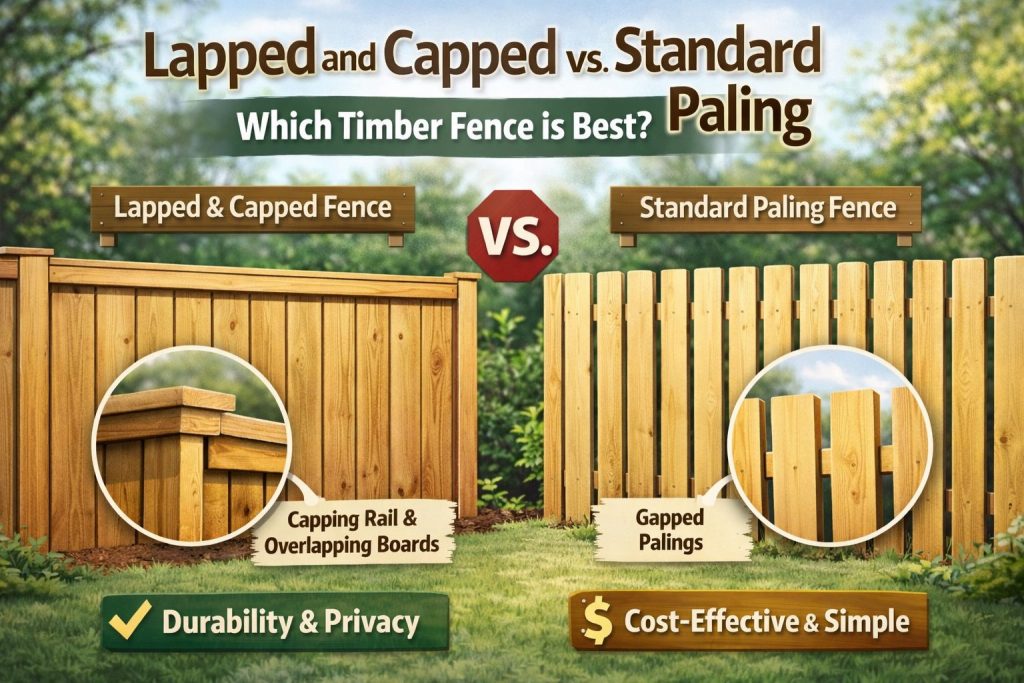
Key Takeaways
- Standard Paling is the budget-friendly choice, but timber shrinkage will cause small gaps to appear over time.
- Lapped and Capped uses double overlapping layers of timber, guaranteeing 100% visual privacy and zero gaps.
- Noise Reduction: The double-layer thickness of Lapped and Capped fencing makes it significantly better at blocking street noise.
- Cost: Lapped and Capped costs 30–40% more upfront but adds greater long-term value and aesthetic appeal to your home.
- Gates: Always ensure your custom timber gates are built on heavy-duty steel frames to prevent sagging.
Is your old fence leaning dangerously? Or perhaps a recent storm finally blew a few panels down?
When it comes time to replace a boundary fence, most homeowners simply ask for “a timber fence,” not realising there are different styles that drastically change the look, privacy, and lifespan of the boundary.
As specialists in timber fencing, we see two main styles dominate Sydney backyards: Standard Paling and Lapped and Capped.
While both use treated pine, the difference in privacy and durability is huge. Here is a breakdown to help you choose the right style for your budget.
What is a Standard Paling Fence?
A standard paling fence is a cost-effective timber boundary made of single treated pine boards nailed side-by-side, which will naturally develop small gaps as the wood dries.
This is the classic “Aussie fence” you see everywhere. It consists of posts, rails, and single palings nailed side-by-side.
- How it works: The palings are butted up against each other.
- The Problem: Treated pine shrinks as it dries in the sun. Over the first 6–12 months, small gaps (3–5mm) will appear between every single paling.
- Privacy Level: Moderate. While people can’t clearly see into your yard, your neighbours will be able to see movement and light through the cracks.
- Best For: Side boundaries where privacy isn’t critical, rental properties, or homeowners on a strict budget.
Which Timber Fence is Best for Total Privacy?
Lapped and capped fencing is the best option for complete privacy because it uses two overlapping layers of timber finished with a top rail, guaranteeing zero gaps.
If you value total privacy, this is the superior choice.
- How it works: We install two layers of palings. The first layer has gaps, and the second layer “laps” over those gaps. The whole fence is then finished with a heavy timber “capping rail” on top.
- The “Gap-Free” Guarantee: Because the palings overlap significantly, even when the timber shrinks, zero gaps open up. You get 100% visual privacy from Day 1 to Day 1,000.
- Acoustic Benefits: That double layer of timber adds mass, acting as a sound barrier. It is excellent for reducing road noise or muffling the sound of a neighbour’s pool pump.
- Aesthetics: The capping rail gives the fence a finished, premium frame that looks fantastic from the street.
Verdict: For street-facing fences or pool areas, Lapped and Capped is the clear winner.
Do Custom Timber Gates Need a Steel Frame?
Yes, custom timber gates should be built with a heavy-duty steel frame to ensure the wood does not warp, sag, or drag on the ground over time.
A fence is only as secure as its gate. There is no point building a solid privacy fence if the gate sags or leaves a massive gap.
We specialise in building custom timber gates that match your new fence line perfectly.
- Design Tip: If you choose a Lapped and Capped fence, we build the gate in the exact same style so it blends seamlessly into the wall.
- The Structural Secret: We use heavy-duty steel frames for our gates. Many cheap “handyman specials” rely on timber bracing, which inevitably sags and drags on the concrete after a year. A steel frame ensures your gate opens smoothly forever.
Why Should You Hire a Carpenter for Fencing?
Hiring a qualified carpenter ensures your fence posts are dug to the correct depth and built with the right load-bearing materials, preventing the fence from leaning in high winds.
You might be tempted to hire the cheapest labour you can find, but fencing is precision work.
When searching for a “carpenter near me,” you want someone who understands posts. The strength of a fence is entirely underground.
- Depth: We dig our post holes to the correct depth (600mm+) to ensure the fence doesn’t lean in high winds.
- Materials: We use H4 Treated Pine (specifically rated for in-ground use) or Hardwood posts to prevent rot at the soil line.
How Much More Does Lapped and Capped Fencing Cost?
Lapped and capped timber fencing generally costs 30% to 40% more than standard paling due to the extra timber required and the longer installation time.
Yes, Lapped and Capped timber fencing costs more—typically 30–40% more than standard paling. Why?
- It uses nearly double the amount of timber (two layers of palings).
- It takes longer to install.
However, the Return on Investment (ROI) is undeniable. It looks better, blocks more noise, and lasts longer.
Summary: Which Timber Fence Should You Choose?
- Choose Standard Paling if: You need a functional boundary on a tight budget.
- Choose Lapped and Capped if: You want total privacy, noise reduction, and a premium look that adds value to your home.
Ready to Secure Your Boundary?
Don’t let a rotting fence ruin your backyard’s appeal.
Contact Sydney Decking Solutions today. Whether you need a simple boundary repair or a premium feature fence with custom timber gates, our team is ready to help.